
Trading Strategy has launched the first fully automated Hyperliquid vault-of-vault strategy. This vault runs a portfolio allocation strategy, allocating capital to other Hyperliquid ecosystem vaults, aiming to deliver smooth returns within the largest DeFi trading ecosystem. The strategy is built on top of Trading Strategy’s proprietary vault data-collection and analysis system, with a DeFi-specialised open-source oracle for live trading.
About Hyperliquid and its vaults
Hyperliquid is the most successful decentralised exchange ("perp DEX") for perpetual futures, with more than half of its assets already real-world assets.
One of the killer features Hyperliquid introduced is open vaults where any trader can offer various trading strategies to other users, somewhat similar to allocating capital as equity funding in traditional markets, except much safer. Vaults have a public, provable track record and standardised entry/exit controls by the Hyperliquid protocol, protecting the depositors.
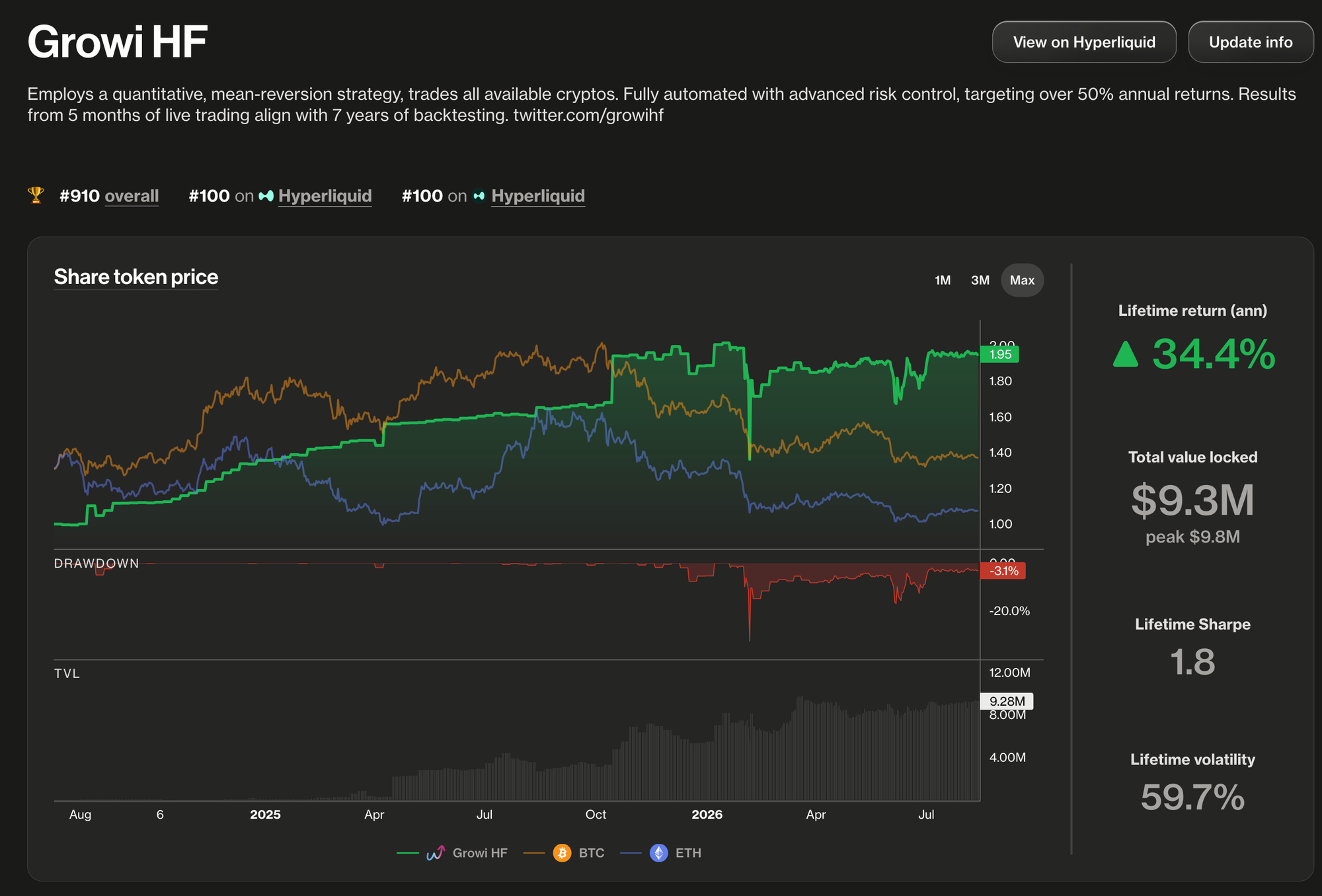
This concept has been hugely popular, and today there are 350+ vaults with $100M in TVL in total, excluding Hyperliquid’s own internal liquidity-provision vault. The best-known vault is Growi, with $100M in TVL and 30% lifetime profit.
How the Hyperliquid vault-of-vaults works
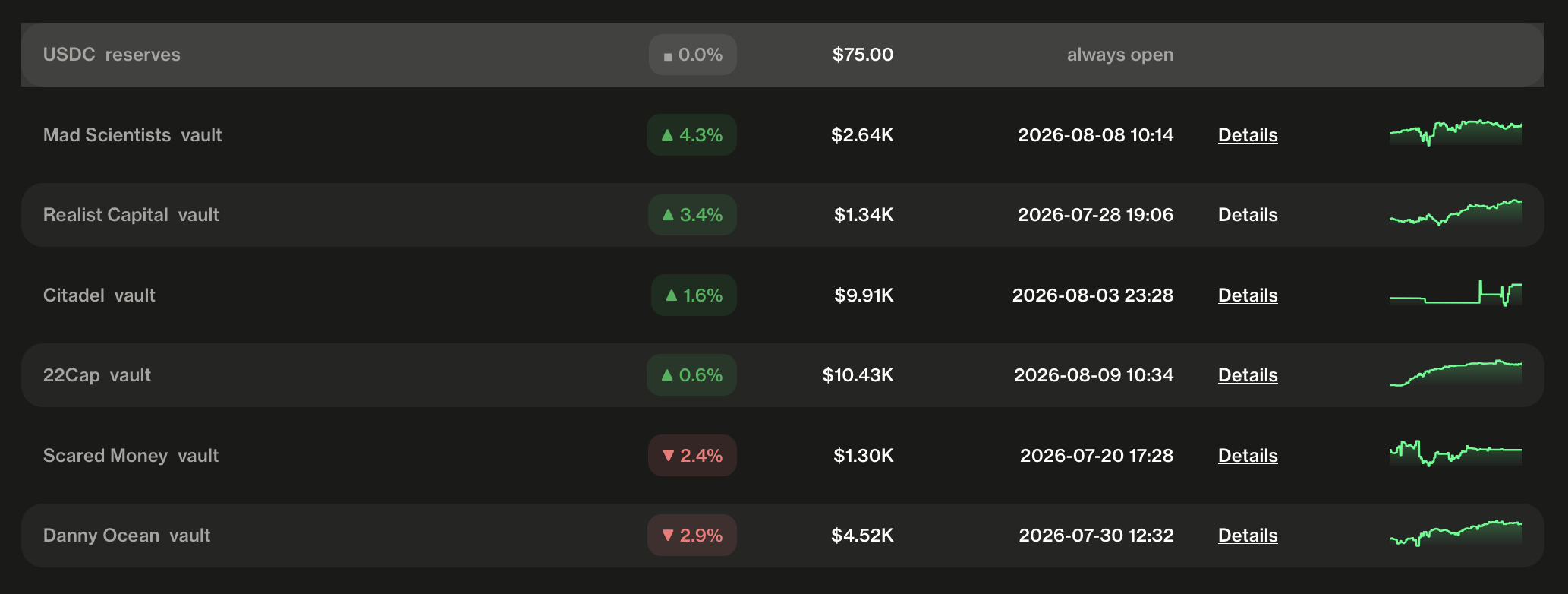
Hyperliquid vault-of-vaults executes a deterministic portfolio allocation strategy across different vault opportunities in the Hyperliquid ecosystem.
The opportunities include, e .g.
- Low-risk algorithmic trading like grid-based market making
- Pair trading and statistical arbitrage
- Directional, discrete, proprietary traders
- Multistrategy algorithmic trading
How is this vault different from other DeFi vaults?
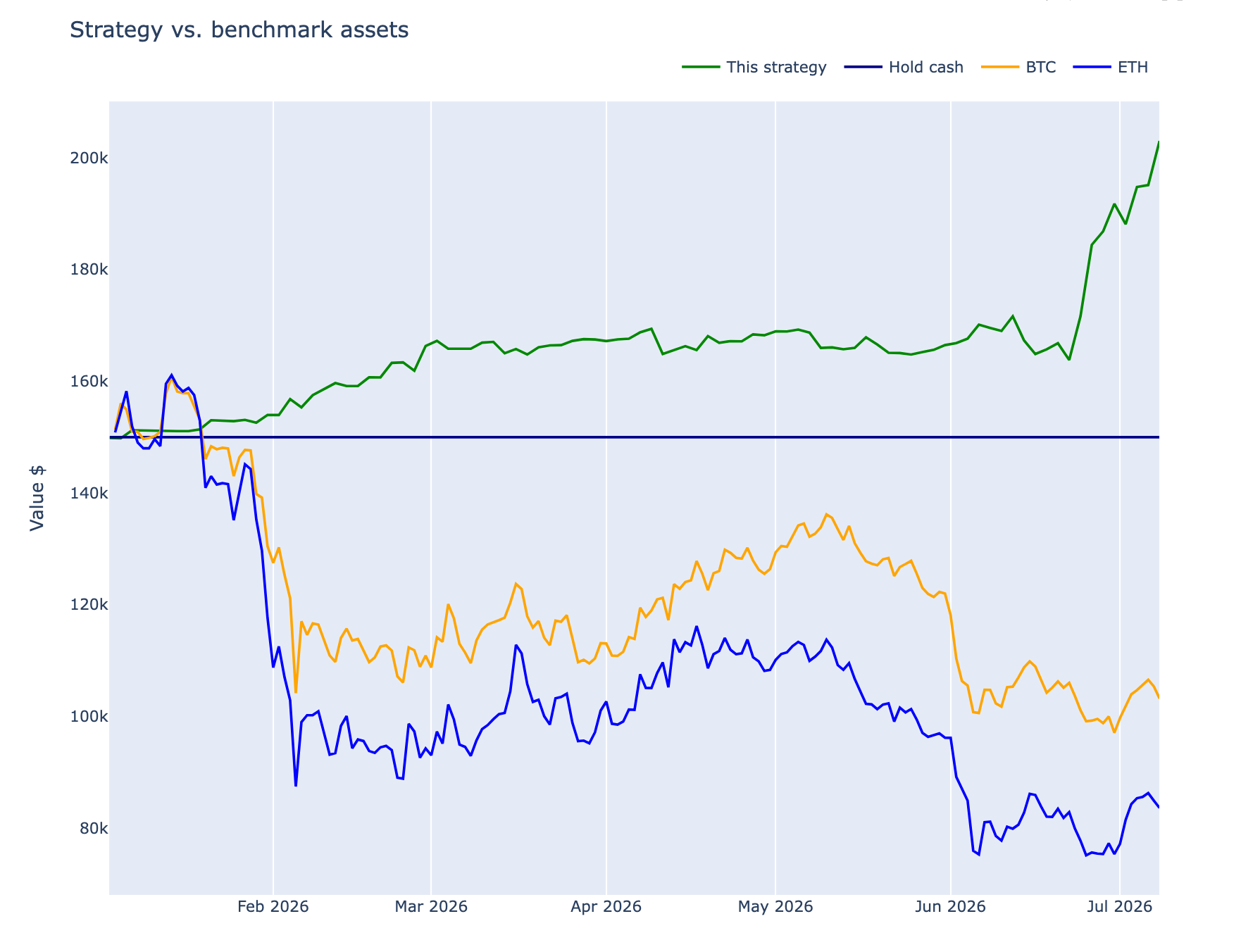
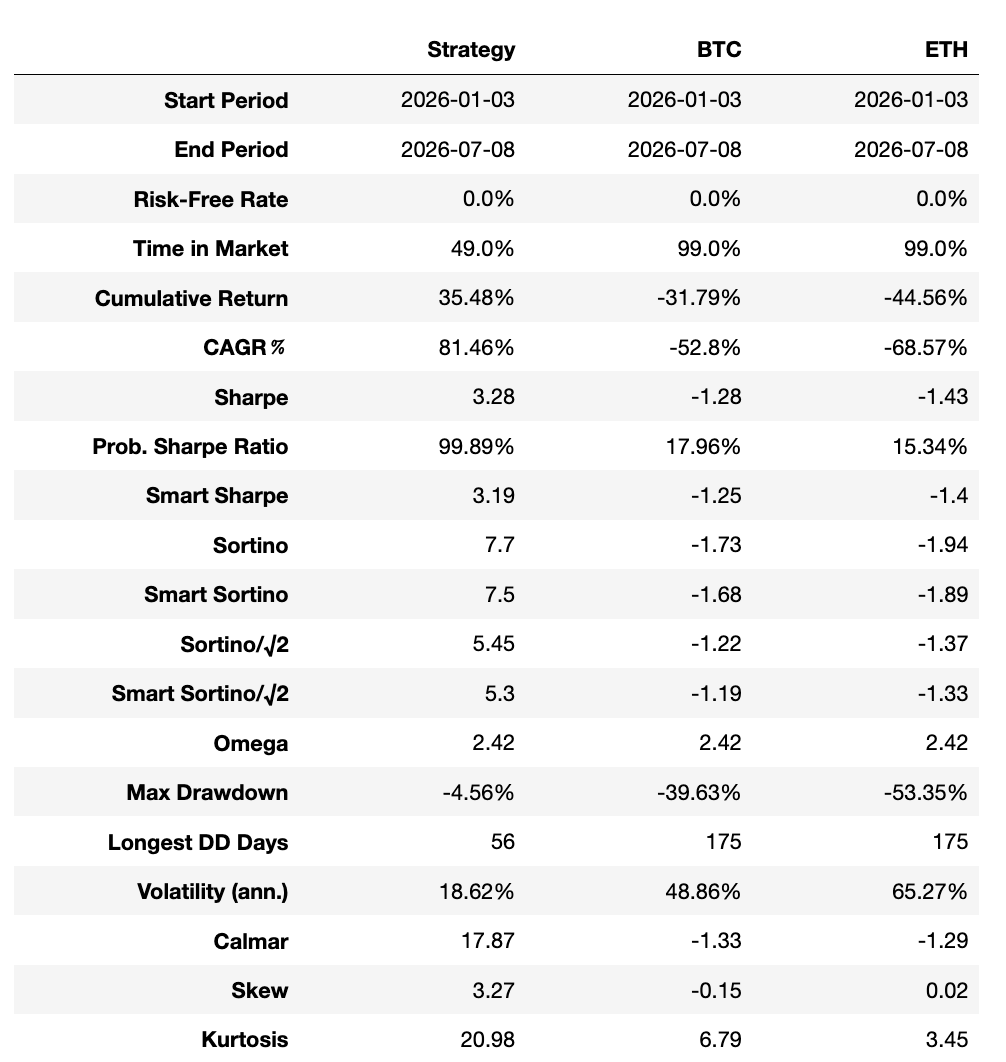
Most decentralised finance vaults are lending-based and/or aiming for delta-neutral returns without any drawdowns. The Hyperliquid vault of vaults has drawdown, but it compensates drawdown with higher returns.
As a rule of thumb, backtests suggest we can achieve a 1:4 ratio between annual returns and drawdown. For example, with a 20% yield, we can estimate a maximum drawdown of 5%.
The goal is risk-adjusted returns: higher risk, higher returns.
This is achieved by not lending to the traders but by providing them with equity funding with a fair profit-and-loss share.
We backtested annualised returns ranging from 20% to 80% (CAGR). Note that Hyperliquid vaults themselves have limited history since September 2025, so the backtesting is more of a guideline. We tested for robustness by removing the most profitable positions; we still get 20%-30% returns.
Past performance is no guarantee of future results.
Deciding allocations
The vault-of-vault runs an algorithmic portfolio construction strategy. The algorithm is open and utilises the proprietary Trading Strategy data collected over the years.
The opportunities are ranked by returns and volatility, balancing both of these factors. Then, the strategy allocates to the shortlisted vaults based on their variance.
Benefiting from diversification
The main benefit of the vault of vaults is automated diversification and profit-seeking rebalances. It is less likely that all vaults will encounter issues at the same time or in a similar manner, which reduces risk compared to an all-in single investment.
For example, in May 2026, one of the best Hyperliquid vaults, in terms of returns and Sharpe ratio, erased most of its gains. This was because the vault operator, until this moment, had focused only on high-frequency automated trading and had made a discretionary bet on the HYPE token price, which proved wrong. In a diversified vault portfolio of e.g. 6 positions, the maximum damage from this kind of human error is 1/6th of the total portfolio.
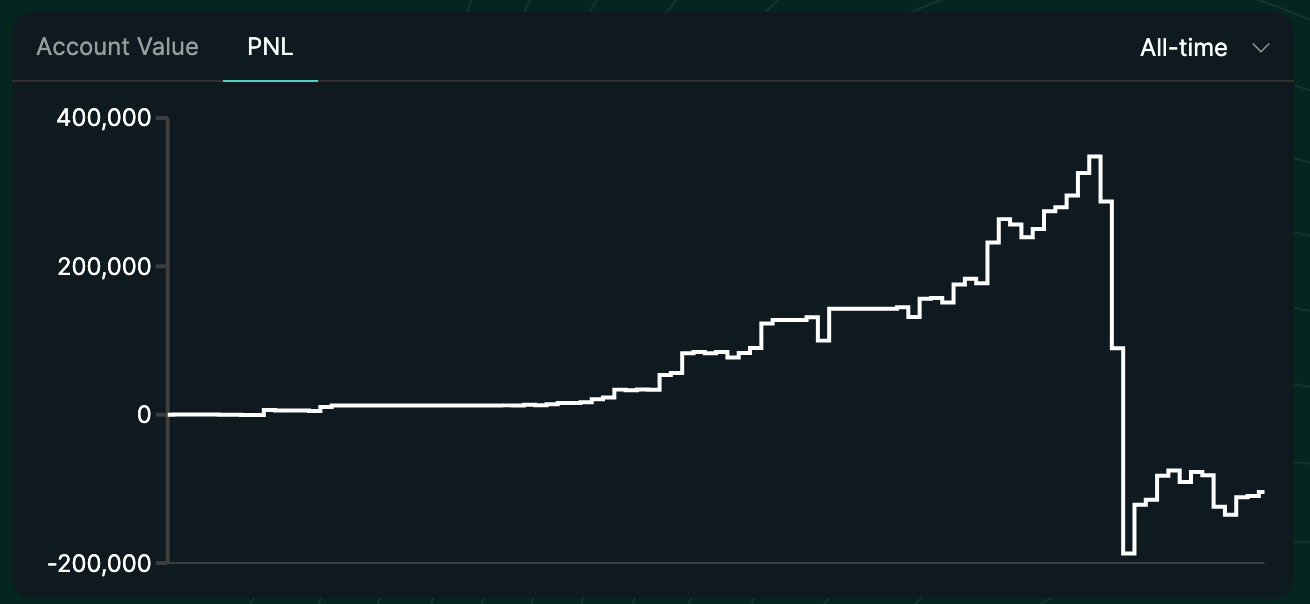
The current strategy variant allocates to six different vaults. Based on our backtests, in the current Hyperliquid ecosystem and under low-volatility market conditions, the highest risk-adjusted returns (Sharpe) are achieved with 4-8 positions held concurrently.
As the Hyperliquid ecosystem expands and more investable opportunities become available, we expect the strategy to maintain concurrent open positions in the 10-20 range.
Capacity
Currently, Hyperliquid perpetual futures vaults have $300M TVL deployed, of which $100M is in user-created vaults. Around 20% of the vaults are investable-grade. This gives us $20M in already-deployed capital to the vaults we’d aim to deploy to. We can estimate capacity at least a couple of millions, but it can grow as Hyperliquid real-world assets from trade.xyz and other HIP-3 providers are added; the vaults can get diversified not only in strategies but also in assets.
To be on the safe side, we start with $150k and gradually increase this as our confidence in the
Using Hyperliquid vault-of-vaults
The vault-of-vaults is a Lagoon-protocol-based vault deployed on the HyperEVM chain. HyperEVM is an EVM-based blockchain from the Hyperliquid team that allows smart contracts to place trades on the Hyperliquid perp DEX.
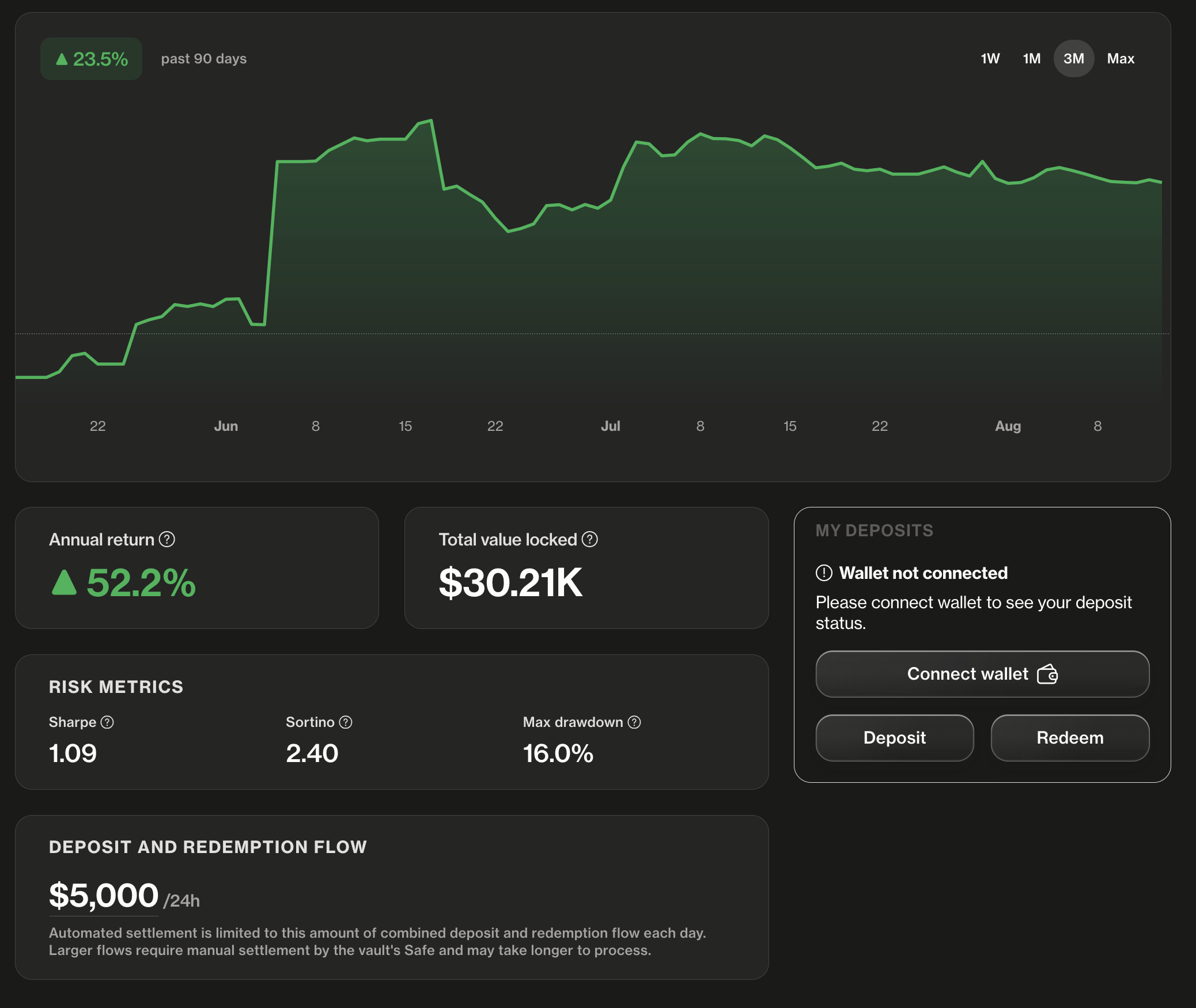
- The vault is denominated in Circle USDC; you need USDC in your wallet to deposit into it.
- HyperEVM uses the HYPE token for gas fees; you need to have HYPE in your wallet to cover the gas fees for the deposit transaction.
We recommend using Rabby and Ambire wallets for interacting with DeFi.
See the vault page and deposits here.
Lock ups
Because the vault of vault depends on the lock-up periods of underlying vaults, redemption processing may take up to 5 days: Hyperliquid HLP vault lock-up is currently 4 days.
Quality, testing and issues with young Hyperliquid ecosystem
We have run the vault through 500+ rebalances and 4,000+ HyperCore/HyperEVM-bridged transactions over several months. These covered a list of issues in the HyperCore/HyperEVM integration caused by Hyperliquid's architectural shortcomings. We have been confirming and fixing these issues as we go.
Based on the forward-testing results, we have run through five different strategy versions to optimise and update both the strategy and execution logic in response to live trading findings. This also caused some kinks in the early equity curve which we believe the latest strategy iterations have overcome.
These have also caused some missed performance early on, as we have worked with this still maturing ecosystem
- Unlike most blockchains, Hyperliquid does not offer good API documentation or a testing environment/integration testing (”Anvil-forks”). Most issues can only be found through live trading testing.
- Hypercore ←> HyperEVM API communication is brittle, and there is no way to confirm whether any action a smart contract executed succeeded or not. For example, it is impossible to know whether a bridged deposit from HyperEVM correctly reached Hyperliquid.
- Hypercore-exposed APIs contain some quirky design decisions, including opaque fees, rounding errors, and constantly changing live trading amounts.
There will still be issues, and sometimes we need to monitor the strategy after encountering new ones, which can cause downtime for vault rebalances and reconciliation.
Hyperliquid itself is deprecating native vaults and wants everyone to move to HyperEVM vaults. We feel this might be a bit of a premature move on our part and Hyperliquid's, due to current architectural shortcomings. While we believe HyperEVM is the future, it still has too many paper cuts to fully unleash the power of next-generation decentralised finance.
Safety and ramp-up
As this is one of the first-of-a-kind decentralised finance vaults, we are ramping up the vault-of-vaults slowly. The DeFi security landscape has had a rough start to the year, and HyperEVM is not yet well studied, with several gaps as discussed above.
Currently, while the Lagoon vault smart contract has undergone several audits and maintains dozens of millions of TVL, Hyperliquid/HyperEVM contains unaudited parts of the code.
In the current version of Hyperliquid vault of vaults strategy deposits and redemptions are throttled to $ 5,000 per day until a proper audit and decentralisation are in place. Smaller deposits are automatically processed while larger deposits are throttled. The vault of vault performs real-time net asset value calculations, and the risk vectors include manipulation of the value of underlying Hyperliquid vault positions, also known as oracle exploits. The throttle will mitigate potential damage if Hyperliquid faces such incidents.
What next
Hyperliquid vault of vault deposits are now open. You are free to use the vault.
For any questions, you can ask on our Discord server, and we are also happy to have one-to-one calls with anyone who is interested in what we do.
We have also started a new Trading Strategy podcast (YouTube, Spotify) where we interview vault curators to learn about their strategies, risk controls and such and to work together to create better vault of vault and portfolio allocation strategies. Tune in. Latest episodes include curators such as Frankencoin, Ember Protocol and TAU Labs.